
Content marketing in 2018 felt like progress, with a focus on posting more and more. 2022 made it crucial. And it’s exhausting in 2026.
Feeds are occupied by polished posts, AI-generated content, and “thought leadership” that lacks substance. It’s a brutal irony. We never made too much content. But today, trust, attention, and impact are more difficult to earn than ever.
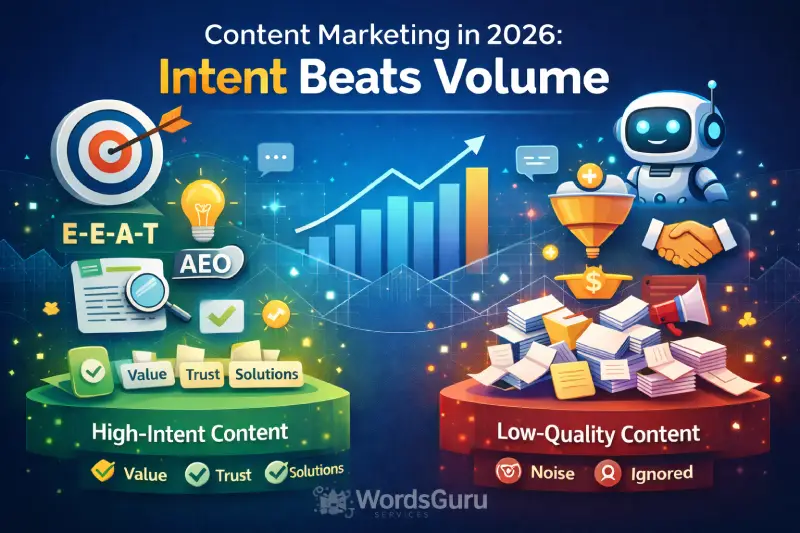
That’s why content marketing is quietly but significantly resetting. Winners are publishing only with intent, but not in volume.
In 2026, content intent matters more than volume, making it more relevant to the audience.
Why Intent is Vital in Content Marketing?
Previously, marketing rewarded quantity. More content resulted in higher SEO reach. More posts increase online presence. But currently, the game is rapidly changing due to AI.
It’s difficult to create a unique proposition while posting continuously.
Search engines, AI-powered discovery tools, and audiences themselves are all filtering actively. Low-intent content, no matter how optimised, is skipped or ignored.
On the other hand, high-intent content is loved, remembered, mentioned, shared, and trusted.
The content marketing strategy for 2026 has also shifted towards AEO to get cited by AI engines, because Gen AI addresses the user intent through raw questions.
What does “Content Intent” mean in Marketing?
Content intent is not just about writing less, but also about its purpose.
How does an Intent-focused approach help?
- Solves a specific problem.
- Provides insights at different stages of the buyer journey.
- Increases conversions and measurable business growth.
Intent connects storytelling and strategy in digital marketing. It addresses audience needs, shows brand expertise, and solves problems in a single piece of content. Eventually, making the content valuable.
AI Made Content Intent Non-Negotiable
AI is not eliminating content volume, but exposing poor thinking.
Google AI mode, Gemini, ChatGPT, Perplexity, Claude, etc., do not reward vague data. They value structure, insights, clarity, and authority.
AI saves time, and human intervention provides meaning.
Winners use AI as an assistant, not completely depending upon it.
How do they use AI?
- Accelerate research.
- Optimise SEO and structure.
- Repurpose high-intent assets
But for insights, manual inputs are crucial for authenticity.
People Trust Less But Remember More
Audiences are tired. They are now overwhelmed by the sheer volume of content, and have become sceptical of generic advice.
That’s why quality is more important than ever.
What High-Intent content includes?
- Real experience.
- Clear point of view.
- Verifiable expertise.
That’s why thought leadership is shifting away from trends and towards conviction-based narratives.
So, what content will rank and convert in 2026?
- Content that helps people with decision-making.
- Original, unique content that educates.
How Intent Shapes Content Marketing?
Traditional SEO and SEM tactics are outdated. Intent-based search optimisation answers queries, helping content rank better on any platform.
- Google SEO prioritises E-E-A-T signals.
- SEM values clarity over tricks.
- Clicks need a hook that is relevant to the audience.
Brands relying solely on content volume will struggle. But intent-driven content pillars get more backlinks, SEO, and AEO.
Intent leads to meaningful content, PPC, SEO, and improves cost efficiency due to relevance.
Reach and Relevance in Digital Marketing
How does Intention influence?
- Influencer marketing.
- Social media ads.
- Guerrilla Marketing.
Virality is short-term. Trust is long-term.
What is the best content strategy for 2026?
- Market segmentation rather than mass reach.
- Audience targeting with precision.
- Reducing dependency on algorithms.
This way, brands build authority, rather than noise, and win in the long term.
Real-Life Examples of High Intent Strategy
HubSpot shifted away from posting a large number of SEO blogs and towards buyer-intent-driven pillar content, reducing low-performing posts.
They aligned content with funnel stages, and prioritised search intent over intensity, improving lead quality and conversions.
Salesforce
Salesforce reduced generic content posting and increased industry-specific content.
Their intent-first approach supports trust building and outperforms reach in the B2B environment.
Nike
Nike transitioned from continuous promotional campaigns to purpose-driven storytelling on its platforms.
Rather than chasing impressions, focused campaigns with stronger intent and emotional resonance resulted in better engagement.
FAQs on Intent-Based Content
Why does Content Intent Matter More?
Audiences are now skipping generic content to seek relevance, clarity, and purpose.
How Intent Impacts Content?
It sets relevant goals, solves problems, guides decisions, and increases conversion rates.
What is the Best SEO Strategy for Intent-Focused Content?
Focus on intent-based keywords, structured content, and real expertise to strengthen E-E-A-T signals.
How AI Impacts Marketing in 2026?
Heavy AI usage helps in speed, but human revision improves relevance.
Which Marketing Strategy Works in 2026?
High intent content marketing helps in decision-making.
Future of Content Marketing
The future of content marketing belongs to brands that genuinely serve their audience.
In a landscape shaped by AI, algorithms, and constant noise, the winning content is not the loudest — it is the most useful. High-intent content helps people think, decide, and move forward with confidence.
Before publishing your next piece, ask a simple question:
Why should this content exist?
If it answers a real problem, adds clarity, or supports a meaningful decision, it will perform — even without high volume. In 2026 and beyond, intent is no longer optional. It’s the foundation of effective content marketing.