
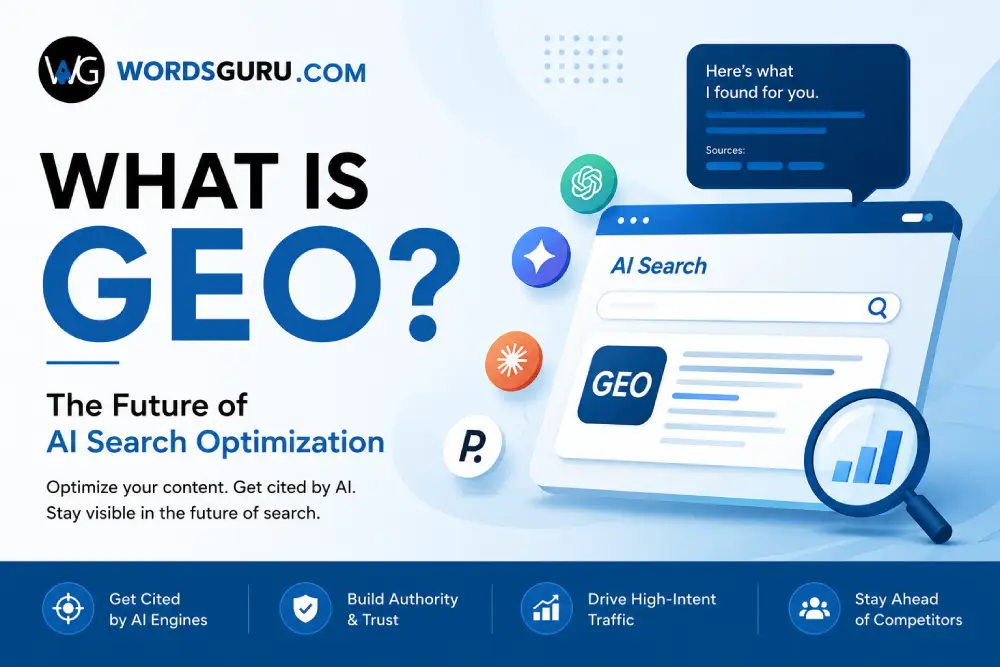
Have you noticed how conversational AI models are completely changing the ways people search for information online today? If content remains uncited by ChatGPT, Perplexity, or Google AI Overviews, your brand stays hidden from millions of buyers. This invisibility occurs because consumer behavior has fundamentally changed. Instead of clicking traditional search links, buyers now ask AI models for direct answers. This major shift is exactly why modern companies must understand what is GEO to survive online.
Generative Engine Optimization is the ultimate playbook for modern digital visibility. Read this comprehensive guide to understand generative engine dynamics and position your business effectively for future growth.
The Simple Definition: What Does GEO Mean?
GEO stands for Generative Engine Optimization. It involves optimizing your content so AI engines find, cite, and recommend your brand. Traditional search engines only point users to external links. Generative engines actually synthesize information from multiple web sources to write a unique response.
GEO vs SEO and AEO
Now that you have your answer to your question, what is GEO, it is vital to understand the differences between GEO vs SEO and GEO vs AEO. Many marketers confuse these three digital marketing terms.
- SEO: Getting Found on Google
Targets traditional search algorithms to rank webpages in standard results. Success means gaining organic traffic, clicks, and keyword positions.
- AEO: Getting Your Answer Extracted
This strategy targets voice search and featured snippets, such as Google AI Overviews. The goal is to capture the single-answer box above standard results, measured by immediate impressions.
- GEO: Getting Your Brand Recommended by AI
This optimization ensures AI platforms recommend your brand name within their generated search answers. Your AI search visibility depends on how frequently and consistently your brand is mentioned alongside relevant industry keywords.
The following table highlights the core differences between these strategies. It provides a clear breakdown of GEO vs AEO alongside traditional search metrics.
| Factor | SEO | AEO | GEO |
| Platform | Google, Bing | AI Overviews, Voice | ChatGPT, Gemini, Perplexity, Claude |
| Goal | Drive user clicks | Win the answer box | Get cited by AI |
| Metric | Rankings, traffic | Snippet appearances | Citation frequency |
| Core Tactic | Keywords, backlinks | FAQ schema, concise answers | E-E-A-T content, third-party mentions |
Why 2026 Is the Year for GEO?
The rapid transition to AI-driven search is measurable. ChatGPT now boasts 900 million weekly active users globally. Google AI Overviews reach more than 2 billion users each month. Traditional search volume faces a massive 25 percent decline as users embrace conversational platforms.
Crucially, a recent study from Ahrefs revealed nearly 28% of the pages cited by ChatGPT have zero organic visibility on traditional Google. Strong traditional rankings do not guarantee that your brand will optimize for AI search platforms. The two systems rely on completely different algorithms.
How AI Search Engines Decide What to Cite?
Understanding the internal mechanics of AI engines helps creators execute effective GEO for business content. The AI retrieval process moves through three distinct operational phases. They are:
1. Query Fan-Out
The AI engine breaks a single user prompt into multiple smaller sub-queries. A basic question can trigger up to ten separate background searches instantly.
2. Source Retrieval
The system retrieves information from forums, editorial pieces, and trusted industry publications. It favors highly structured text that offers recent updates.
3. Synthesis
This model integrates the retrieved data into a single response. It cites the most reliable and authoritative sources.
AI platforms focus on expert authors, reliable sources, and comprehensive coverage of topics. This is why it is crucial to create E-E-A-T content.
6 Practical Steps to Optimize for AI Search
A complete redesign of your website is not essential for a digital strategy shift. You should incorporate these six tactical steps into your existing content creation process:
1- Audit Your Robots.txt File
Make sure that your website doesn’t inadvertently exclude modern AI crawlers. Ensure your core content pages are accessible for GPTBot, ClaudeBot, and PerplexityBot.
2. Create an LLMs.txt File
To help guide language models, add a clean text file to your root directory. This LLMs.txt file explains your site’s purpose and highlights your most important URLs.
3. Structure Every Article for Direct Answers
Place a summary that is clear at the top of every page. AI systems pay most attention to the first 200 words when extracting information.
4. Build Topical Authority with Supporting Content
Publish comprehensive content clusters instead of single isolated articles. Create detailed guides and clear FAQs for your core topics.
5. Earn Third-Party Citations
Build digital PR mentions across industry forums, review platforms, and news sites. AI engines trust brands that are consistently mentioned by trusted third-party sources.
6. Add FAQ and How-To Schema
Implement structured data code to help AI systems parse your text easily. Ensure you use explicit schema tags on every informational blog post.
The Business Case: What GEO Traffic Actually Looks Like
Data reveals that traffic originating from AI engines is highly valuable. On average, visitors redirected via ChatGPT maintain a 15-minute spend time on websites. This easily beats the 8-minute average traffic duration seen from traditional search engine clicks.
These pre-qualified visitors convert at much higher rates on transactional pages. Using ChatGPT SEO and Perplexity SEO captures buyers who already trust the AI’s recommendation and want to buy instead of browsing multiple links.
Only 16% of businesses currently track their overall performance across conversational networks. Capitalizing on this low adoption creates a massive competitive window, ensuring you get cited by AI algorithms consistently.
FAQs
- Is GEO replacing SEO?
No, it serves as an extra layer on top of traditional optimization. The two practices must run together because traditional search still drives significant web traffic.
- Which AI platforms does GEO target?
It specifically targets conversational engines, making frameworks like ChatGPT optimization and Perplexity SEO crucial components of a modern digital strategy.
- When can you expect to notice results from GEO?
Visible results can appear within 4 to 6 months of publishing your content. This timeline can vary based on your existing LLM optimization strategy.
- Can small businesses use GEO to beat zero click search trends?
Yes, because AI engines prioritize deep niche expertise over massive corporate backlink profiles. This makes it easier to combat zero click search trends.
Final Thoughts
Understanding what is GEO is no longer an optional marketing concept for businesses. It is a vital strategy for surviving the massive AI shift. Brands must optimize content for both human readers and AI retrieval systems to remain visible online today. Failing to optimize for large language models means letting competitors capture critical visibility and influence your prospective target audience first. Modern search visibility requires high-quality content that simultaneously satisfies complex algorithms and secures reliable user-facing recommendations online.
Partner with WordsGuru Services to build authoritative, high-converting content explicitly engineered to capture dominant AI search platform citations.