
Most of what gets written and spoken about generative engine optimization is opinion. While these opinions sound interesting and impressive, they are not as convincing as verified numbers. Why? When a client asks whether GEO deserves financial allocation, opinion may not get the conversation so far, but a number usually does. This roundup revisits GEO statistics 2026 that are worth highlighting. Every number is backed by a source, so these can power your decision-making. So, let’s get started!
GEO Statistics 2026: How Far AI Search Adoption Grew
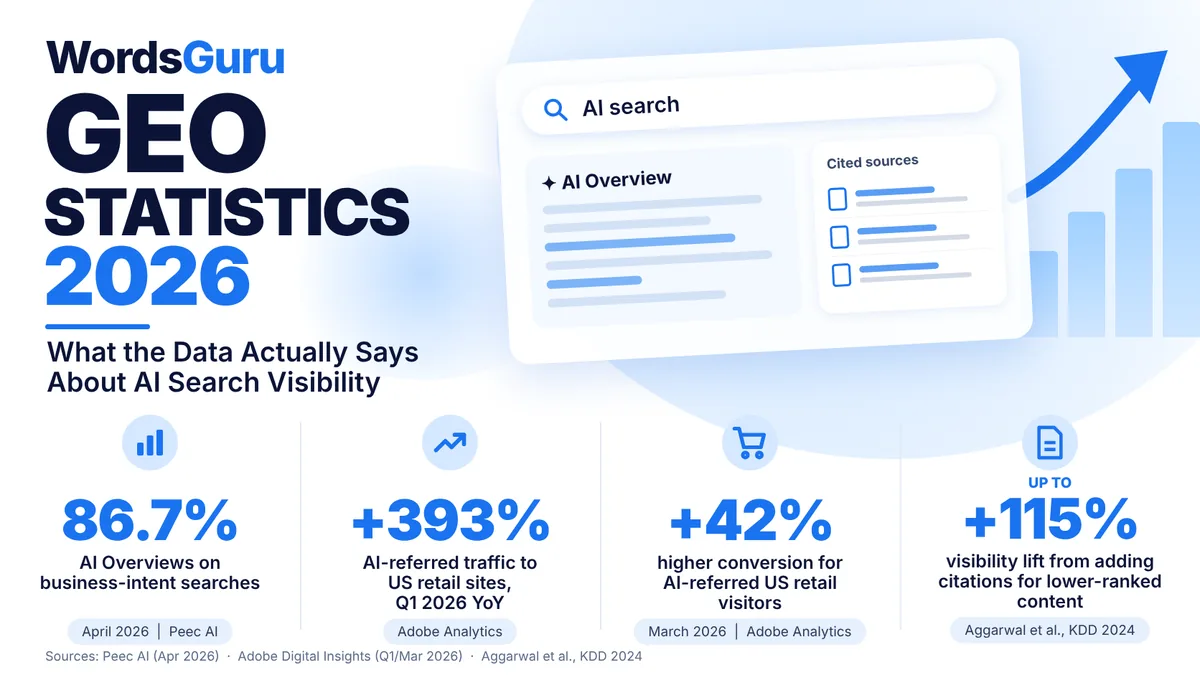
Google’s AI Overviews appeared on 86.7% of business-intent searches in April 2026. A year earlier, that figure was 56.9%. That’s a jump of nearly 30 points in twelve months, on the exact queries where buyers compare vendors.
AI search adoption shows up on the platform side too. Between June 2025 and May 2026, monthly visits across generative AI tools rose 70% to 9.5 billion, with unique visitors up 57% to 655 million.
Marketers’ behavior and approach have also changed. 92% say they plan to optimize for AI search. However, only 40.6% are doing it. Plenty of teams have GEO “in the pipeline” but have not acted on it, and that’s a huge gap between strategy and execution.
What GEO Statistics 2026 Show About Zero-Click Search
The click data is where things change drastically. In the US, 58.5% of Google searches end without a click, rising to 75% for mobile devices. The zero-click trend is also spreading across different demographics.
Another finding that stands out is sessions ended outright 26% of the time after a search returned an AI summary, against 16% when it didn’t. This means people just got their answer and left.
For brands still measuring success by organic clicks alone, these figures explain why that scoreboard is starting to miss the real game, because it is undercounting every zero-click search where your brand was read but never visited.
What Actually Gets Content Cited in AI Answers
Researchers from Princeton, Georgia Tech, and IIT Delhi tested content strategies across 10,000 queries and multiple engines. The results give GEO something SEO rarely had this early: peer-reviewed evidence of what works.
Which Tactics Moved the Needle Most
- Citing external sources lifted visibility by up to 115% for lower-ranked content
- Adding a sourced statistic improved visibility by roughly 41%
- Adding a direct quotation improved visibility by roughly 28%
Separately, 83% of AI Overview citations come from pages that sit outside the organic top 10.

That last stat alone should change how most teams prioritize content writing and marketing. A page-one ranking helps you get indexed and trusted, but it doesn’t decide who gets quoted.
The Business Case Backing GEO Statistics 2026
Visibility only matters if it converts, and the early revenue data is stronger than many marketers expect. Adobe’s research suggests that AI-referred visitors to US retail sites converted 42% better than other traffic in March 2026. A year earlier, that same traffic was not yielding good results.
Across sites, a whopping 56% saw a higher number of conversions from AI-driven sessions, with high-traffic sites converting at 7.05% from AI against 5.81% from organic.
In terms of spend, the GEO market 2026 in the US is projected to reach $365.4 million at a 42.9% CAGR. As per an article published on Yahoo Finance, the value of the global GEO market in 2026 is $1.09 billion, and it is projected to reach $32.92 billion by 2036 at a 40.6% CAGR.
Why Brand Visibility in AI Search Stays Inconsistent?
Even strong performers cannot assume a citation, once earned, will repeat.
- Only 30% of brands maintain consistent visibility across AI answers from one session to the next.
- Roughly 1 in 10 AI citations came from a self-promotional listicle between December 2025 and February 2026, with no sign of engines correcting for it.
- Reddit was the number one or two most cited domain on every major AI engine as of March 2026.
Frequently Asked Questions
1- Is GEO replacing SEO in 2026?
Neither term is disappearing. The data shows 83% of AI Overview citations still come from real, indexed pages, most sitting outside the traditional top 10. SEO fundamentals still get a page into the pool an AI system can pull from. GEO decides whether that page actually gets pulled.
2- Why does a brand show up in AI answers one day and vanish the next?
AI answers are generated fresh for each session, so citations shift in a way rankings don’t. With only 30% of brands appearing consistently, some disappearing is normal. A drop in content visibility that lasts several weeks is the thing worth investigating.
3- Which content change has the biggest effect on citations?
Based on the Princeton research, citing credible external sources produced the largest lift, up to 115% for lower-ranked pages. Adding sourced statistics and direct quotations both helped too, just by smaller margins.
4- Do AI search visitors actually convert or just browse?
Current data says they convert, often better than average traffic. Adobe measured a 42% conversion lift for AI-referred retail visitors in March 2026, a reversal from the previous year, when AI traffic still converted worse than organic.
Conclusion
The pattern across every credible dataset points in the same direction. AI search visibility is not a future trend or concept, but a measurable channel that is connected to revenue and which most brands are still underprepared for. These GEO statistics 2026 figures make the opportunity and the risk equally clear. The brands that are receiving consistent citations are creating an advantage that will be increasingly difficult to close every quarter you don’t tap into GEO.
Ready to show up in the answers, not just the results? WordsGuru and Wrds.Pro builds the evidence, narrative infrastructure, and GEO strategy that gets founder-led brands cited by the AI systems your buyers are already asking. Get in touch to see exactly where your brand stands in AI search today.